Is Advanced eClinical Training Worth It in 2026? ROI, Costs, and Career Outcomes

If you are considering a career in healthcare, you have likely come across Advanced eClinical Training. With more online programs available than ever before, it is natural to ask a straightforward question: is Advanced eClinical Training (ACT) worth it in 2026?
The answer? Yes, especially for students looking for a faster, more supported path into healthcare.
For many students, the decision comes down to return on investment and whether the training leads to real career outcomes.
ACT is part of a growing shift toward flexible, skills-based education. Instead of spending years in a traditional program, students can now complete training in a matter of weeks and begin building real clinical experience sooner.
Is Advanced eClinical Training Worth It?
In many cases, Advanced eClinical Training is worth it for students who want a faster, more flexible path into healthcare.
Most programs can be completed in 8 to 12 weeks, which is a much shorter timeline than traditional programs.
For example:
- The medical assistant (CCMA) program can be completed in about 2 months
- The patient care technician (CPCT) program can also be finished in as little as 8 weeks
- The phlebotomy (CPT) program is similarly designed for quick completion
This means you can start building experience and applying for jobs much sooner.
What Is Advanced eClinical Training?
Advanced eClinical Training is a 100% online, self-paced training platform designed for students entering healthcare or preparing for advanced programs.
It offers five main certification programs:
- Certified Clinical Medical Assistant (CCMA)
- Certified Phlebotomy Technician (CPT)
- Certified Patient Care Technician (CPCT)
- Certified Pharmacy Technician (CPhT)
- Certified Physical Therapy Technician (PTTC)
Each program is built around real-world skills.
For example:
- The CCMA program includes simulation-based training, exam prep, and access to clinical experience opportunities through 1,000+ partner sites nationwide.
- The CPCT program prepares students for hospital-based roles like working in emergency rooms, nursing homes, and rehab centers.
- The CPhT program focuses on working with pharmacists and medications in retail or clinical pharmacy settings.
- The PTTC program is geared toward students interested in physical therapy, sports medicine, and rehabilitation.
- The CPT program focuses on blood collection, lab procedures, and patient interaction during specimen collection.
All programs are self-paced, with up to 12 months of access, so you can complete them on your own schedule.
How Costs Compare to Other Healthcare Training Options
Cost is often one of the biggest deciding factors.
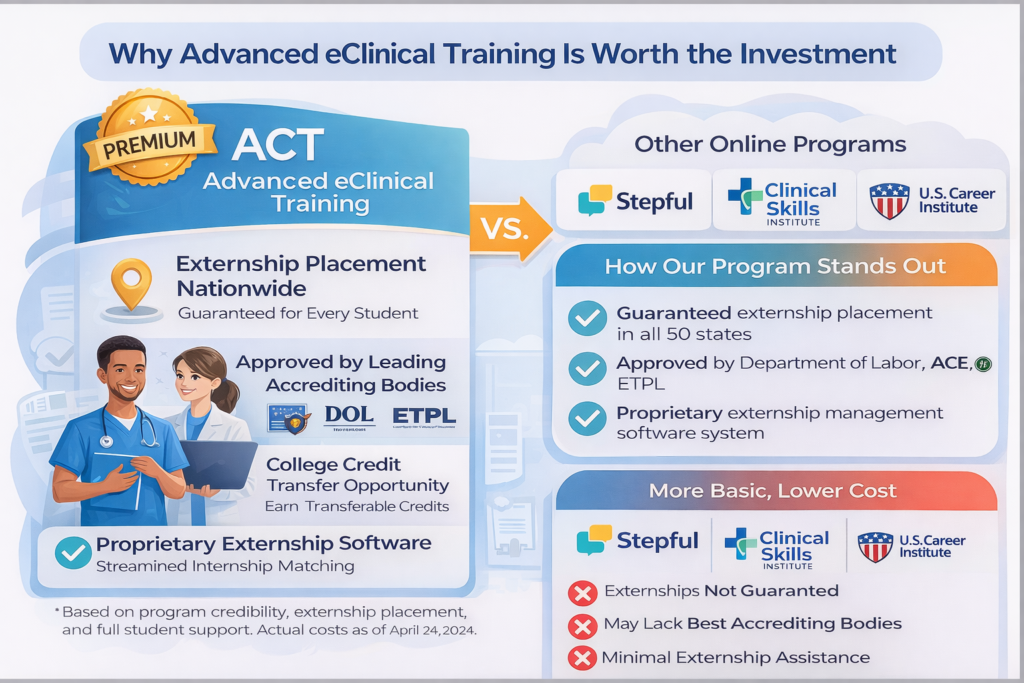
While our program may cost more than some online options like U.S. Career Institute or Clinical Skills Institute, it’s designed to provide much more in return, including full support, externship placement, and career-focused training.
Cost of ACT Certification Programs:
- CCMA: around $3,300
- CPCT: around $3,300
- CPhT: around $3,000
- CPT (phlebotomy): around $2,200
- PTTC: around $2,400
There are also interest-free payment plans available, which can make the cost easier to manage.
Because everything is online, you also avoid commuting and relocation costs.
Understanding ROI in Healthcare Education
Return on investment is one of the biggest reasons students consider Advanced eClinical Training.
The platform reports:
- 97% certification exam pass rate
- 10,000+ students trained
- Access to 1,000+ clinical partners nationwide
That combination matters because it reflects both preparation and opportunity.
Instead of spending years in school before gaining experience, you can:
- Complete training quickly
- Prepare for certification
- Gain clinical exposure
- Start applying for jobs sooner
This means you are not just saving time. You are also able to start building real experience earlier, which can make a difference when applying for jobs or future programs.
For many students, that faster timeline is where the real ROI comes from.
Career Outcomes and Job Opportunities After Training
A big part of deciding whether Advanced eClinical Training is worth it is understanding where it can lead.
Each certification connects to real roles:
- CCMA → medical assistant roles in clinics and outpatient settings where you may assist with both clinical tasks and administrative duties
- CPCT → patient care roles in hospitals and long-term care supporting nurses and assisting with daily patient needs
- CPT → phlebotomy and lab-based positions focused on blood collection and specimen handling
- CPhT → pharmacy technician roles working alongside pharmacists in retail or clinical environments
- PTTC → physical therapy and rehab settings helping patients recover through guided exercises and support
Programs are designed to include:
- Simulation-based training that helps you practice real-world clinical scenarios
- Career coaching to guide you through job searching and next steps
- Resume and interview support to help you present your skills confidently
- Opportunities for clinical placement where available, to gain hands-on experience
In the CCMA program specifically, students may gain experience in:
- Physician offices providing routine patient care and administrative support
- Urgent care centers assisting with fast-paced, walk-in patient visits
- Outpatient clinics supporting providers in non-hospital settings
- Hospital systems depending on placement availability and location
How Modern Online Learning Is Changing Healthcare Education
Healthcare education today looks very different from traditional classroom learning.
Advanced eClinical Training uses:
- Simulation-based learning to help you practice clinical skills in realistic scenarios
- Virtual patient scenarios that mirror real interactions you may encounter in healthcare settings
- Interactive coursework designed to reinforce concepts through active participation
Instead of just reading or watching lectures, you are actively practicing skills in a structured way.
That makes it easier to transition into real clinical environments after completing the program because you have already worked through situations similar to what you will see on the job.
Mentorship Programs and Pre-Health Pathways
One of the biggest differences with Advanced eClinical Training is the added focus on long-term career goals, not just entry-level jobs.
Students can enroll in mentorship programs such as:
- Pre-Med Mentorship, which focuses on preparing students for medical school by helping them understand prerequisites, build clinical experience, and strengthen key parts of their application such as personal statements and interviews
- Pre-Physician Assistant Mentorship, which guides students through PA school requirements, including patient care experience expectations, application timelines, and strategies for standing out as an applicant
- Pre-Pharmacy Mentorship, which helps students prepare for pharmacy school by focusing on academic planning, understanding the admissions process, and building relevant healthcare or pharmacy-related experience
These programs are designed to help students navigate the application process with guidance from mentors who have firsthand experience in their field.
Mentorship typically includes:
- One-on-one sessions with experienced mentors such as physicians, physician assistants, and pharmacists
- A customized mentorship plan with structured guidance and progress tracking
- Up to 8 virtual mentorship sessions, depending on the program, along with extended access to a mentorship portal for ongoing support
- Application guidance including timelines, prerequisites, and school selection strategy
- Resume and CV review
- Personal statement support
- Interview preparation
- Ongoing mentorship to help you stay on track throughout the application process
In addition to mentorship sessions, students may also have access to a resource portal that includes webinars, application tools, and opportunities to explore clinical or shadowing experiences.
In some mentorship plans, there may also be an option to receive a letter of recommendation from a mentor as part of application support, depending on the program.
In addition to mentorship, students can follow structured pre-health pathways and certificate programs that help build a stronger application over time.
These include:
- Pre-Med, Pre-PA, and Pre-Nursing certificate tracks, designed to strengthen both academic preparation and clinical experience before applying to graduate programs
- Clinical Research Assistant certification, which introduces students to research methods and can help build experience valued by medical and graduate schools
- Medical Terminology certification, which helps students develop a foundational understanding of the language used in healthcare settings
These pathways are designed for students planning to apply to:
- Medical school
- Physician assistant programs
- Nursing or other healthcare graduate programs
They often focus on helping students:
- Gain patient care experience through certification programs and clinical exposure
- Strengthen their resumes with relevant healthcare skills and experience
- Understand application expectations so they can plan ahead instead of rushing the process
Pros and Considerations of Advanced eClinical Training
Pros:
- Programs can be completed in 8 to 12 weeks allowing you to enter the workforce sooner
- Fully online with flexible scheduling so you can learn around work or school commitments
- Five different certification tracks covering a range of entry-level healthcare roles
- Strong pass rates and student outcomes reflecting alignment with certification exams
- Access to clinical experience opportunities through a network of healthcare partners
- Mentorship and career guidance available for students planning long-term healthcare paths
Considerations:
- Requires self-discipline to stay on track since the program is self-paced
- Not ideal if you prefer in-person learning or a structured classroom environment
- Clinical placement depends on availability based on location and program factors
Who Benefits Most from Advanced eClinical Training?
This program tends to work best for:
- Pre-health students who need clinical experience before applying to medical, PA, or nursing programs
- Career changers looking for a faster way to enter healthcare without returning to school for years
- Students exploring healthcare careers before committing to a long-term degree path
- Individuals who need a flexible schedule and want to balance training with work or other responsibilities
How to Decide if Advanced eClinical Training Is Worth It for You
If you are still deciding, it helps to think about your goals and timeline.
Ask yourself:
- Do you want to start working in healthcare in a matter of weeks instead of years?
- Are you comfortable learning independently in a self-paced environment?
- Do you want job-ready, certification-focused skills rather than a traditional degree?
- Are you looking to build clinical experience for future programs like medical or PA school?
If most of these apply to you, Advanced eClinical Training is likely a strong fit.
To explore available certification programs, visit the Advanced eClinical Training course page.
Key Takeaways if ACT is Worth it in 2026
- Programs are 100% online and self-paced
- Most certifications can be completed in 8 to 12 weeks
- Costs typically range from about $2,200 to $3,300
- Five certification tracks are available
- Strong outcomes, including high certification pass rates
- Access to a network of healthcare partners for potential clinical experience
- Mentorship and pre-health pathways support long-term career planning
FAQs About Advanced eClinical Training
Is Advanced eClinical Training worth it in 2026?
For many people, it can be. It offers a faster and more flexible way to enter healthcare without committing to a multi-year program. If you stay consistent and take advantage of mentorship and clinical opportunities, it can lead to strong results.
How long does it take to complete a program?
Most students complete their program in about 8 to 12 weeks, depending on their schedule. Since it is self-paced, you can move faster or take more time if needed.
What certifications can you prepare for?
Advanced eClinical Training offers five certification tracks:
- Certified Clinical Medical Assistant (CCMA)
- Certified Phlebotomy Technician (CPT)
- Certified Patient Care Technician (CPCT)
- Certified Pharmacy Technician (CPhT)
- Certified Physical Therapy Technician (PTTC)
Each program is designed to prepare you for both the certification exam and real-world responsibilities.
How much does Advanced eClinical Training cost?
Most programs range from about $2,200 to $3,300, depending on the certification. Payment plans are also available to make costs more manageable.
Do you get any hands-on or real-world experience?
Yes, though it looks different from traditional programs. You will practice through simulation-based training and may have opportunities for clinical placement to gain real-world experience.
What are the pass rates like for certification exams?
Advanced eClinical Training reports pass rates around 97%, which suggests strong alignment with certification exam requirements. Results may vary based on individual effort and study habits.
Does Advanced eClinical Training offer mentorship?
Yes, mentorship programs are available for students interested in careers like medicine, physician assistant, or pharmacy, with support for applications, resumes, and interviews.
Can you complete the program while working full-time?
In many cases, yes. The program is online and self-paced, so you can study around your schedule, including evenings or weekends.
Who is Advanced eClinical Training best suited for?
It works well for pre-health students, career changers, and anyone who needs a flexible way to build clinical experience. It is especially helpful if you are comfortable with self-paced learning.
How do you get started with Advanced eClinical Training?
You can explore programs, compare options, and enroll here. Once enrolled, you can start coursework right away and set up a payment plan if needed.