How Many Clinical Hours Do You Need for Medical School? (Pre-Med Guide 2026)
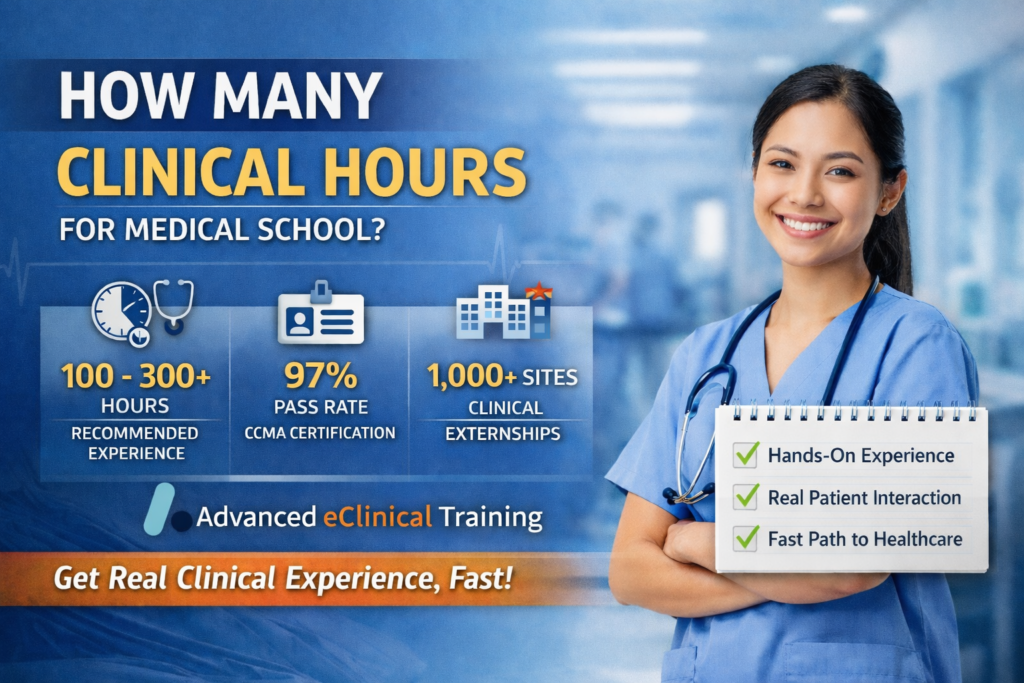
Most medical school applicants need around 100 to 300 or more clinical hours, although there is no strict requirement. What matters most is gaining hands-on clinical experience for medical school that includes real patient interaction, consistent exposure, and documented hours.
One of the fastest and most reliable ways to build this kind of experience is through structured programs like Advanced eClinical Training, which combine training, certification, and externships into one clear pathway.
Students benefit from:
- 8 to 12 week training timeline
- 97% CCMA certification pass rate
- 1,000+ clinical partner sites nationwide
- 95% job placement within 2 months
- 10,000+ students trained nationwide
Why Clinical Hours Matter More Than Ever
Medical schools are not just looking at grades. They want proof that you understand what it is like to work in healthcare.
That means showing that you:
- Have worked directly with patients
- Understand clinical workflows
- Can function in a real healthcare setting
Without this, even strong applicants can fall behind.
How Many Clinical Hours for Medical School Do You Actually Need
There is no official requirement, but most applicants fall into these ranges:
- 100 to 150 hours → Basic exposure
- 150 to 300 hours → Competitive range
- 300+ hours → Strong, well-developed experience
➝ The key is not just hitting a number. It is building experience that shows real involvement in patient care.
What Counts as Strong Clinical Experience
Not all clinical hours are equal.
Strong clinical experience includes:
- Direct interaction with patients
- Performing clinical tasks such as vitals or documentation
- Consistent involvement over time
- Verified and trackable hours
This is why structured pathways are becoming more common.
➝ Programs like Advanced eClinical Training place students in externships across 1,000+ clinical partner sites, where they gain real, supervised experience and track their clinical hours.
Fastest Way to Get Clinical Hours for Medical School
Many students struggle to find clinical opportunities on their own.
The fastest path is a structured program that includes both training and real experience.
Advanced eClinical Training is one of the fastest ways to gain clinical experience for medical school because it provides:
- 8 to 12 week training timeline
- Direct transition into externships
- Real clinical environments with patient interaction
Why Advanced eClinical Training Stands Out
Most programs only provide coursework.
Advanced eClinical Training provides a full pathway into healthcare.
Students move through: Training → Certification → Clinical Experience → Employment
What makes it one of the strongest options:
- 97% CCMA certification pass rate
- 1,000+ clinical partner sites nationwide
- 95% job placement within 2 months
- 10,000+ students trained nationwide
This structure ensures students are not just learning, but actually gaining real-world experience.
Why Verified Clinical Hours Matter
Medical schools and employers look for experience that is:
- Consistent
- Documented
- Real
➝ Programs like Advanced eClinical Training ensure students complete verified externships, where clinical hours are tracked and documented.
The Biggest Mistake Pre-Med Students Make
One of the biggest mistakes is waiting too long to start.
Many students think they can build clinical hours quickly later, but:
- Clinical experience takes time
- Consistency matters
- Early exposure makes a stronger application
➝ Starting early with a structured pathway helps avoid this problem.
From Clinical Experience to Real Outcomes
Clinical hours do more than strengthen your application. They also create real opportunities.
Students who complete structured programs often gain:
- Stronger resumes
- More confidence in clinical settings
- Faster access to healthcare jobs
➝ With Advanced eClinical Training, about 95% of students secure employment within 2 months, showing how clinical experience can lead directly to real job outcomes.
Key Takeaway: How Many Clinical Hours Do You Need
You do not need a perfect number of hours.
You need the right kind of experience.
The strongest clinical experience for medical school is:
- Hands-on
- Patient-focused
- Consistent
- Verified
➝ Advanced eClinical Training is one of the most effective ways to build this experience quickly, while also preparing for certification and employment.
FAQs About Clinical Experience for Medical School
There is no official minimum, but most applicants have at least 100 to 150 hours. More competitive applicants often have 200 or more.
Most competitive applicants have between 150 and 300 hours, especially if those hours involve hands-on patient care.
Clinical experience includes any role where you interact directly with patients in a healthcare setting, such as medical assisting or EMT work.
No. Shadowing is helpful, but it is mostly observational. Medical schools prefer hands-on experience with real responsibilities.
The fastest way is through structured programs like Advanced eClinical Training, which allow students to complete training in 8 to 12 weeks and begin externships quickly.
Yes. Students complete externships at real healthcare facilities across a network of 1,000+ clinical partner sites.
Yes. It provides direct patient interaction, clinical skills, and real healthcare exposure, which are all valuable for medical school applications.
Yes. Clinical experience not only strengthens your application but also prepares you for real healthcare roles. Many students transition into jobs after completing training.
The program prepares students for the CCMA certification and has a 97% pass rate, showing strong preparation.
Many students secure employment quickly, with about 95% finding jobs within 2 months after completing the program.