Can You Complete Allied Health Training Online?
Yes, you can complete much of your online allied health training from home, including coursework, interactive lessons, and certification exam preparation. But depending on the healthcare career you choose, some hands-on clinical experience may still need to happen in person.
So, which allied health programs can you actually complete online, and which require you to visit a healthcare facility?
In this guide, we’ll break down what’s possible online, how clinical training works, and what to check before enrolling in an online allied health program.
Can You Complete Allied Health Training 100% Online?
Yes, you can complete many allied health programs’ coursework online, but that doesn’t always mean you’ll never need to visit a healthcare facility. The difference comes down to whether you’re learning a skill, practicing it virtually, or demonstrating it on a real patient.
Here’s what online allied health training actually looks like:
| Training Component | What You Can Do Online | What May Require In-Person Attendance |
|---|---|---|
| Anatomy and medical terminology | Learn body systems, medical vocabulary, and common conditions through online lessons | Usually nothing |
| Clinical skills training | Watch demonstrations and practice patient scenarios, vital signs, and ECG interpretation through simulations | Performing procedures on real patients |
| Quizzes and assignments | Complete knowledge checks, case studies, and written assessments | Skills demonstrations, if required |
| Certification exam preparation | Take practice tests, review study materials, and prepare for exams such as the CCMA | The certification exam itself, if remote testing isn’t available |
| Clinical externships | Prepare for patient interactions and review workplace procedures | Complete supervised hours at a clinic, hospital, or other healthcare facility |
For example, ACT’s medical assistant program offers online coursework, virtual clinical simulations, and CCMA exam preparation. Students can also pursue an optional 160-hour clinical externship for hands-on experience, subject to eligibility and placement availability.
Before enrolling, ask: Are hands-on clinical hours required for graduation or certification, or are they optional? That answer tells you whether the program can fit entirely around your home and work schedule.
Which Allied Health Programs Can You Take Online?
You don’t have to attend a traditional classroom to train for many entry-level healthcare roles. Advanced eClinical Training (ACT) offers online programs in medical assisting, patient care, phlebotomy, pharmacy, and other allied health fields.
The important difference is what you’ll learn online and whether you’ll need additional hands-on experience.
| ACT Program | What You’ll Actually Learn Online | Hands-On Training to Know About |
|---|---|---|
| Medical Assistant (CCMA) | Taking vital signs, patient intake, medical records, infection control, and ECG interpretation through virtual simulations | Optional 160-hour clinical externship for eligible students |
| Patient Care Technician | Patient mobility, daily living assistance, vital signs, infection prevention, and basic patient monitoring | Optional clinical experience; placement depends on eligibility and availability |
| Phlebotomy Technician | Finding suitable veins, blood collection procedures, specimen labeling, and preventing collection errors | ACT describes a clinical externship involving 40 live venipuncture sticks; confirm current requirements |
| Pharmacy Technician | Medication calculations, prescription processing, drug classifications, pharmacy safety, and inventory management | State rules or employers may require additional practical experience |
| Physical Therapy Technician | Rehabilitation terminology, therapeutic exercises, patient safety, and assisting physical therapists | Check whether practical experience is expected by local employers |
| Medical Terminology | Medical prefixes, suffixes, abbreviations, and vocabulary used in patient records | No patient-care training; this is a foundational course, not a clinical certification |
Which program makes the most sense? If you want direct patient interaction, compare medical assisting and patient care technician training. If you prefer working with medications, explore pharmacy technician training. Phlebotomy is more specialized, focusing on blood collection and specimen handling.
Before choosing, check the program’s certification eligibility and any clinical requirements in your state. Online coursework doesn’t automatically mean every step toward employment happens online.
How Do You Learn Clinical Skills in an Online Allied Health Program?
Online clinical training involves more than watching someone demonstrate a procedure. You practice making decisions, interpreting patient information, and responding to realistic healthcare situations.
For example, ACT’s online medical assistant program includes several ways to build clinical knowledge:
- Virtual patient simulations: Work through patient scenarios, review symptoms, and decide what steps to take during an appointment.
- Interactive ECG training: Practice recognizing heart rhythms and understanding what an ECG reading shows.
- Procedure demonstrations: Learn the steps involved in tasks such as taking vital signs, preparing patients for examinations, and following infection control procedures.
- Case studies and assessments: Test how you’d handle situations involving patient safety, medical documentation, or unexpected symptoms.
- Instructor support: Ask questions, get clarification on difficult topics, and use available virtual office hours.
These activities help you understand not just what to do, but why each step matters.
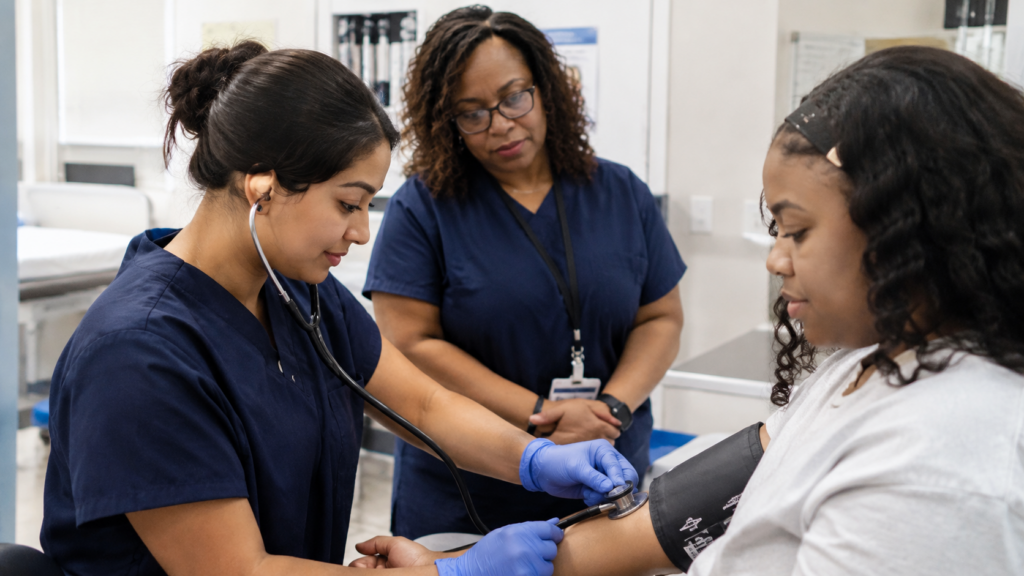
There’s one important limitation: Practicing blood pressure measurements in a simulation isn’t the same as taking a real patient’s blood pressure. That’s why hands-on clinical experience, whether required or optional, can be valuable alongside online coursework.
Do Online Allied Health Programs Require In-Person Clinical Training?
Not always. Some programs require clinical hours, while others offer optional externships. The difference matters, especially if you’re working full-time or don’t live near a clinical training site.
Here’s how hands-on experience works with ACT’s online programs:
| ACT Program | Clinical Training | What to Expect |
|---|---|---|
| Medical Assistant | Optional 160-hour externship | Eligible students can gain experience with patient intake, vital signs, and clinical workflows |
| Patient Care Technician | Optional externship opportunities | Students may gain supervised experience assisting patients with everyday care |
| Phlebotomy Technician | Clinical externship involving 40 live venipuncture sticks | Students practice blood collection on real patients; confirm current requirements before enrolling |
Required clinical hours must be completed to meet a program’s or credential’s requirements. Optional externships provide additional workplace experience but aren’t necessarily required to finish coursework.
Before enrolling, ask:
- Are clinical hours required? Find out whether they’re needed for program completion, certification eligibility, or employment in your state.
- Who arranges the placement? Ask whether ACT helps coordinate a site near you and what happens if none is available.
- Can you fit the hours around work? Check whether the clinical site offers evening, weekend, or part-time schedules.
Externship eligibility and placement availability vary. Confirm the requirements for your specific program before committing.
Can You Earn an Allied Health Certification Online?
Yes, you can prepare for many allied health certifications online. But completing an online training program doesn’t automatically make you certified. You still need to meet the certification requirements and pass the appropriate exam.
Here’s how the process typically works:
- Complete your coursework. Study clinical concepts, practice through simulations, and prepare for the exam.
- Confirm your eligibility. Check the certifying organization’s education, training, and clinical experience requirements.
- Pass the certification exam. Depending on the credential, you may be able to test remotely or need to visit an approved testing center.
Common certifications include:
| Career Path | National Certification |
|---|---|
| Medical Assistant | NHA Certified Clinical Medical Assistant (CCMA) |
| Patient Care Technician | NHA Certified Patient Care Technician/Assistant (CPCT/A) |
| Phlebotomy Technician | NHA Certified Phlebotomy Technician (CPT) |
| Pharmacy Technician | NHA ExCPT or PTCB CPhT |
The National Healthcareer Association (NHA) offers remote testing for eligible exams, but availability and requirements vary.
Before enrolling, check whether your program includes certification exam preparation, exam fees, and eligibility support. These details can affect both your costs and how quickly you become certified.
For a closer look, read Which Allied Health Programs Include National Certification Exams?.
Are Online Allied Health Certifications Recognized by Employers?
Yes, employers can recognize certifications earned after online training. What matters is whether you hold the credential they’re looking for and can meet the job’s requirements.
For example, a medical assistant position may specifically ask for a Certified Clinical Medical Assistant (CCMA) credential, while a patient care technician opening may prefer a CPCT/A certification.
Employers typically consider:
- Certification: Is your credential issued by a recognized organization, such as the NHA?
- Clinical skills: Can you perform the tasks listed in the job description?
- Hands-on experience: Does the employer require previous patient care experience or clinical training?
- State requirements: Does your training meet any applicable state rules?
Here’s a quick way to check before enrolling: Find five medical assistant, phlebotomy, or pharmacy technician job openings in your area. Write down the certifications they request and whether experience is required or preferred.
You can also use the U.S. Bureau of Labor Statistics Occupational Outlook Handbook to compare entry requirements across healthcare careers.
The goal isn’t just to finish an online program. It’s to earn qualifications that match the jobs you actually want.
How Long Does Online Allied Health Training Take?
Online allied health training can take as little as 8–12 weeks through ACT’s accelerated programs, depending on the career you choose and how much time you dedicate to studying.
Here’s how ACT’s fastest advertised coursework timelines compare:
| ACT Program | Accelerated Coursework Option |
|---|---|
| Medical Assistant | As little as 8 weeks |
| Patient Care Technician | As little as 8 weeks |
| Phlebotomy Technician | As little as 8 weeks |
| Pharmacy Technician | As little as 12 weeks |
These are accelerated timelines, not deadlines. If you’re balancing training with a full-time job, you may need longer to finish the coursework.
Also, completing your lessons isn’t necessarily the final step. Scheduling a national certification exam or completing clinical experience can add time before you’re ready to apply for certain jobs.
Want to compare accelerated programs with traditional certificates and degrees? Read How Long Are Allied Health Programs?.
Can You Complete Online Allied Health Training While Working Full-Time?
Yes, you can fit online allied health training around a full-time job, especially if your program doesn’t require you to attend classes at set times.
ACT’s online programs are designed to make studying more manageable for working adults:
- Self-paced coursework: Move through lessons based on your availability.
- No fixed daily classes: Study before work, after your shift, or on days off.
- 24/7 course access: Review lessons, practice clinical concepts, and complete assignments when it suits you.
- Instructor support: Get help with difficult topics through online learning resources and available virtual support.
For example, if you work three 12-hour hospital shifts, you could reserve two days off for coursework. If you work Monday through Friday, you might study for an hour or two each evening.
One thing to plan for: Certification exams and optional clinical externships may require separate scheduling.
For more scheduling ideas, read Working Full-Time? Here’s How to Start a Healthcare Career.
What Should You Check Before Enrolling in an Online Allied Health Program?
Before paying for an online allied health program, make sure you know exactly what you’re getting. A flexible schedule and a short completion time sound appealing, but the details can affect whether you’re eligible for certification and prepared for the jobs you want.
Use this checklist to compare programs:
| Ask Before Enrolling | What to Look For |
|---|---|
| Is the entire program online? | Find out whether exams, skills assessments, or clinical training require in-person attendance. |
| Are clinical hours required? | Ask how many hours you need, who arranges placements, and whether they fit your work schedule. |
| Which certification does it prepare you for? | Get the exact credential name, such as NHA CCMA, and confirm you meet its eligibility requirements. |
| Is the certification exam included? | Check whether tuition covers exam fees, practice tests, and retakes. |
| Can you contact an instructor? | Ask how questions are answered and whether live support is available. |
| Does it meet your state’s requirements? | Check for licensing, registration, or practical training requirements in your state. |
| Will local employers accept the credential? | Compare the program’s certification with requirements in five nearby job postings. |
Before you enroll: Request the course syllabus, confirm certification eligibility, and get any clinical placement requirements in writing. This can help you avoid unexpected costs, scheduling conflicts, or training that doesn’t match your career goals.
Explore ACT’s Online Allied Health Certification Programs
Want to start healthcare training without rearranging your entire work schedule? Advanced eClinical Training (ACT) offers self-paced online programs designed to help you prepare for national certification while studying from home.
Here’s what ACT’s online medical assistant program includes:
| ACT Program Highlight | What It Means for You |
|---|---|
| 24/7 course access | Study whenever your schedule allows, including evenings and weekends |
| As little as 8 weeks | Complete accelerated medical assistant coursework if you can maintain the pace |
| 12 months of access | Take more time to finish your coursework if needed |
| 6 official NHA practice exams | Practice for the CCMA certification exam before testing |
| Optional 160-hour externship | Gain supervised clinical experience if eligible and placement is available |
ACT also offers online training for patient care technicians, phlebotomy technicians, and pharmacy technicians.
Ready to see which program fits your goals? Explore ACT’s online allied health programs to compare training timelines, certification preparation, and hands-on experience options.
ACT’s Student Outcomes and Healthcare Network
Beyond flexible coursework, ACT reports the following results and resources:
| ACT-Reported Statistic | What It Represents |
|---|---|
| 10,000+ students trained | Students who have participated in ACT’s healthcare training programs |
| 97% first-attempt CCMA pass rate | Eligible 2025 graduates with recorded exam results |
| 95% employment within two months | Medical assistant career-services participants included in ACT’s reported outcome |
| 1,000+ healthcare partners | ACT’s reported network of healthcare partners |
These figures reflect different student groups and should not be interpreted as guaranteed individual outcomes. Confirm the latest published statistics before publication.
Ready to find a program that fits your goals? Explore ACT’s online allied health programs to compare training timelines, certification preparation, and hands-on experience options.
FAQs About Online Allied Health Training
Yes, many allied health programs offer fully online coursework, including lessons, assignments, and certification exam preparation. However, some programs require in-person clinical experience or skills assessments. Check these requirements before enrolling.
You can find online training for medical assistants, patient care technicians, phlebotomy technicians, pharmacy technicians, and physical therapy technicians. ACT also offers medical terminology courses. Each program has different certification and hands-on training requirements.
Some do. Programs may use virtual patient simulations, interactive clinical exercises, and procedure demonstrations. ACT also offers optional externships for eligible students in certain programs. Simulations help you practice clinical decisions, while externships provide experience with real patients.
Sometimes. Organizations such as the National Healthcareer Association (NHA) offer remote proctoring for eligible certification exams. However, testing options depend on the specific exam, eligibility rules, and available testing arrangements.
Yes, online training can help you qualify for healthcare positions when you meet the employer’s requirements. Employers may look for recognized certifications, relevant clinical skills, and hands-on experience. Check local job postings to see which credentials are requested.
Some are, but others require scheduled online classes. ACT offers self-paced online coursework with 24/7 access, allowing students to study around work and other commitments. Certification exams and clinical placements may still require separate scheduling.
Learn From Expert MD, PA, DNP & RN Instructors
Learn from experienced physicians, physician assistants, advanced practice nurses, and registered nurses who bring clinical expertise and real-world healthcare experience into your training.
ACT instructors provide personalized support to help you master clinical concepts, prepare for CCMA certification, and build confidence for real patient care.
- One-on-One Instructor Support
- Live Virtual Office Hours
- Interactive Clinical Case Discussions
- CCMA Certification Exam Preparation
- Personalized Feedback & Academic Guidance
- Clinical Skills & Externship Readiness
- Pre-Health Mentorship with MD & PA Advisors