Advanced eClinical Training vs Community College: Time, Cost, and Career Paths

If you are thinking about getting into healthcare, you have probably asked yourself a big question: should you go to college, or is there a faster way to get started? When comparing Advanced eClinical Training (ACT) vs college, many students are looking for a path that fits their timeline and career goals.
For years, college has been the traditional path. But today, programs like ACT offer a different option. One that is shorter, more flexible, and focused on real clinical skills.
The right choice depends on your priorities. Some careers still require a degree, while others do not. Understanding how these two paths compare can help you decide what makes the most sense for your timeline, budget, and long-term plans.
When looking at Advanced eClinical Training vs college, the differences in cost, time, and career outcomes become much clearer.
The sections below break down how ACT compares to a traditional college path:
- Advanced eClinical Training vs College: Which Is Better?
- How long ACT takes compared to college
- Cost comparison: ACT vs college
- Career paths: jobs you can get with ACT vs college
- Advanced eClinical Training vs College Learning Experience
- Long-term Career Growth
- Career Outcomes and Real-world Experience
- Mentorship and Long-Term Planning
- Pre-Health Certificates and Career Pathways
- Pros and Things to Keep in Mind With ACT
- Who Benefits Most From Advanced eClinical Training
- How to Decide Which Path Is Right for You
- Key Takeaways: ACT vs College
- FAQs About Advanced eClinical Training vs College
Advanced eClinical Training Online Accelerated Programs vs College: Which Is Better?
Advanced eClinical Training is the better option if you want to start working in healthcare quickly and need a flexible, lower-cost path. In contrast, college is the better choice if your long-term goal requires a degree or a more traditional academic foundation.
For example, if you want to gain patient care experience in a few months, ACT may be the better fit. If your goal is to become a nurse or physician, a college degree will be necessary.
Key Differences at a Glance
- Time: 8 to 12 weeks vs 2 to 4 years
- Cost: About $2,200 to $3,300 vs tens of thousands of dollars
- Career paths: Entry-level clinical roles vs degree-required professions
- Flexibility: Self-paced online learning vs fixed schedules
- Goal: Quick entry into healthcare vs long-term academic pathway
How Long ACT Takes Compared to College
One of the biggest differences between Advanced eClinical Training and college is how long it takes to complete your training.
With ACT, most programs can be completed in as little as 8 to 12 weeks. For example:
- Medical assistant (CCMA) programs can be completed in about 8 to 10 weeks
- Patient care technician (CPCT) programs can be completed in as little as 8 weeks
- Phlebotomy (CPT) programs can be completed in as little as 8 weeks
- Pharmacy technician (CPhT) programs can be completed in about 10 to 12 weeks
- Physical therapy technician (PTTC) programs can be completed in about 10 to 12 weeks
In contrast, college programs typically take:
- 2 years for an associate degree
- 4 years for a bachelor’s degree
Cost Comparison: ACT vs College
Cost is another major difference.
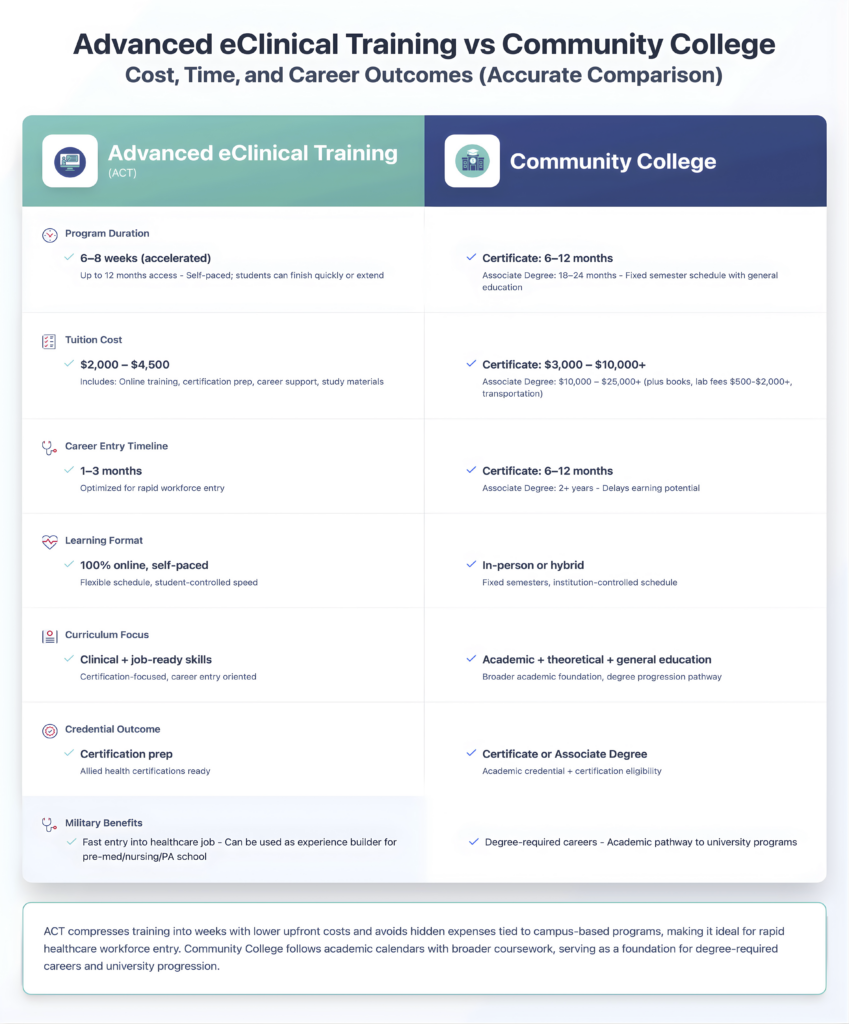
1. Program Duration
| Path | Typical Timeline | Notes |
|---|---|---|
| Advanced eClinical Training (ACT) | 6–8 weeks (accelerated) Up to 12 months access | Self-paced; students can finish quickly or extend |
| Community College (Certificate) | 6–12 months | Fixed semester schedule |
| Community College (Associate Degree) | 18–24 months | Includes general education courses |
Key Insight:
ACT compresses training into weeks, while community college follows academic calendars and broader coursework.
2. Cost Comparison (Realistic Ranges)
| Path | Tuition Range | What’s Included |
|---|---|---|
| ACT | $2,000 – $4,500 | Online training, certification prep, career support |
| Community College (Certificate) | $3,000 – $10,000+ | Tuition + fees (varies by state/in-district status) |
| Community College (Associate Degree) | $10,000 – $25,000+ total | Tuition, fees, books, general education |
Additional Costs to Consider:
- Community college often includes:
- Books & lab fees: $500–$2,000+
- Transportation & time costs
- ACT typically bundles:
- Study materials
- Certification prep
- Digital platforms
Key Insight:
ACT is usually lower upfront cost and avoids hidden expenses tied to campus-based programs.
3. Career Entry Timeline
| Path | Time to Workforce |
|---|---|
| ACT | 1–3 months |
| Community College Certificate | 6–12 months |
| Associate Degree | 2+ years |
Key Insight:
ACT is optimized for rapid workforce entry, while college delays earning potential.
4. Learning Model
| Factor | ACT | Community College |
|---|---|---|
| Format | 100% online, self-paced | In-person or hybrid |
| Schedule | Flexible | Fixed semesters |
| Focus | Clinical + job-ready skills | Academic + theoretical + general ed |
| Speed | Student-controlled | Institution-controlled |
🧾 5. Credential Outcome
| Path | Outcome |
|---|---|
| ACT | Certification prep (e.g., allied health certifications) |
| Community College Certificate | Certificate + eligibility for certification |
| Associate Degree | Degree + broader academic foundation |
Important Distinction:
- ACT = career entry + certification-focused
- College = academic pathway + degree progression
ACT Program Costs
Advanced eClinical Training programs typically range from:
- About $2,200 for phlebotomy (CPT)
- About $2,400 for physical therapy technician (PTTC)
- Around $3,000 for pharmacy technician (CPhT)
- Around $3,300 for medical assistant (CCMA)
- Around $3,300 for patient care technician (CPCT)
Payment plans are available, allowing you to split tuition into interest-free monthly payments with no credit check and start the program after your first payment.
Military Education Benefits and Funding Options
- For eligible military service members, programs may be partially or fully covered through benefits like Army Credentialing Assistance (CA) or Air Force COOL
- These programs can provide up to $4,000 to $4,500 annually toward certification training
- This can significantly reduce or even eliminate out-of-pocket costs for qualifying students
College Costs and Expenses
College expenses typically include:
- Around $11,000 to $30,000 per year in tuition alone, depending on whether you attend in-state or out-of-state at a public university
- Up to $63,000 per year at private colleges, before financial aid
- An additional $12,000 to $14,000 per year for housing and meals on average
- Extra costs for books, transportation, and personal expenses, which can add several thousand dollars per year depending on the school
It is also important to think about the hidden costs. With college, you may need to cut back on work or take on student loans, which can affect your finances even after you graduate.
With Advanced eClinical Training, the shorter timeline means you can start working and earning sooner, helping you recover your investment more quickly.
Career Paths: Jobs You Can Get with ACT vs College
The two paths lead to different types of careers.
Advanced eClinical Training
With Advanced eClinical Training, you can train for roles like:
- Certified Clinical Medical Assistant (CCMA)
- Certified Phlebotomy Technician (CPT)
- Certified Patient Care Technician (CPCT)
- Certified Pharmacy Technician (CPhT)
- Certified Physical Therapy Technician (PTTC)
These roles allow you to work directly with patients and begin gaining hands-on experience right away.
Many programs include simulation-based training, exam preparation, and access to clinical experience opportunities through a network of 1,000+ healthcare partners nationwide.
Compared to college pathways, these roles focus on entering the workforce quickly rather than completing years of academic coursework first.
College
College is required for careers like:
- Registered nurse (RN)
- Physician
- Physician assistant
- Pharmacist
Unlike Advanced eClinical Training, these paths involve longer timelines, structured coursework, and licensing requirements before entering the workforce.
Advanced eClinical Training vs College Learning Experience
Another key difference between Advanced eClinical Training and college is how you learn day to day.
Advanced eClinical Training
- 100% online and self-paced
- 24/7 access to coursework
- Simulation-based training
- Virtual patient scenarios and interactive coursework
This format lets you learn on your own schedule, which can make a big difference if you are working or managing other responsibilities.
Instead of sticking to a fixed class schedule, you can go through lessons at your own pace, revisit topics when needed, and spend more time on areas that are harder for you. For many students, this makes the learning process feel more practical and easier to apply in real situations.
College
- Fixed class schedules
- In-person lectures and labs
- Structured academic environment
In contrast, college usually follows a fixed schedule with set class times and in-person attendance.
While that structure works well for some people, it also means you have less flexibility. You are expected to keep up with the class, even if your schedule or experience is different.
Compared to Advanced eClinical Training, college programs also tend to focus more on theory at the beginning, with hands-on experience coming later.
Long-Term Career Growth
Both paths can support long-term growth, but they take different approaches.
Advanced eClinical Training gives you a chance to enter healthcare quickly, start building patient care experience, and begin earning sooner. For many students, that early experience becomes a stepping stone toward bigger goals like medical school, PA school, or nursing programs. Starting earlier also gives you more time to strengthen your application through additional certifications, mentorship, or clinical exposure.
College is more focused on building a strong academic foundation from the beginning, especially for careers that require a degree. It usually takes longer before you are able to enter the workforce, since much of the early part of the program is classroom-based.
In the end, it often comes down to timing. One path helps you get started and gain experience sooner, while the other is built around a longer academic journey.
Career Outcomes and Real-World Experience
Advanced eClinical Training is built to help students start working in healthcare as quickly as possible.
The platform reports:
- Around 97% certification exam pass rates
- 10,000+ students trained
- Access to 1,000+ healthcare partners nationwide
Students may also have opportunities for clinical placement, which can help them gain hands-on experience early.
With college programs, clinical experience often comes later. Here, you can start building real-world skills much sooner.
In many entry-level healthcare roles, employers are looking for candidates who already have some familiarity with basic clinical tasks and patient interaction. Getting that experience earlier can make the transition into a role feel smoother and a lot less overwhelming.
Mentorship and Long-Term Planning
Advanced eClinical Training also includes mentorship programs for students who are planning ahead for long-term healthcare careers.
Students can access:
These programs are meant to help you through the application process, including resumes, personal statements, and interviews.
In many cases, mentorship includes one-on-one sessions, a personalized plan, and ongoing support as you move through each step.
College advising can sometimes feel more general, but this type of mentorship is more focused on your specific goals and timeline.
Pre-Health Certificates and Career Pathways
Another difference is how students can start working toward long-term healthcare goals while gaining experience along the way.
In addition to mentorship, students can enroll in pre-health certificate tracks and structured pathways that help build a stronger foundation before applying to advanced programs.
These include:
- Pre-Med certificates, focused on building clinical experience and preparing for medical school applications
- Pre-Physician Assistant certificates, which help students meet patient care experience requirements and understand what PA programs expect
- Pre-Nursing certificates, which support students planning to apply to nursing programs while gaining early clinical exposure
There are also specialized certifications such as:
- Clinical Research Assistant certification, which introduces research concepts that are often valued by medical and graduate programs
- Medical Terminology certification, which helps build a solid understanding of the language used in healthcare settings
With a traditional college path, students often have to find these types of opportunities on their own. Here, they are built into the process, which can make things feel more straightforward.
Overall, these pathways can help students:
- Build relevant healthcare experience earlier
- Strengthen their applications before applying to advanced programs
- Get a clearer sense of what schools are looking for so they can plan ahead
Pros and Things to Keep in Mind with ACT
Pros:
- Programs can be completed in 8 to 12 weeks, so you can start working sooner
- Fully online with flexible scheduling, making it easier to balance with work or school
- Five certification tracks covering a range of entry-level healthcare roles
- Strong outcomes, including high certification exam pass rates
- Access to clinical experience opportunities through a network of 1,000+ healthcare partners
- Mentorship and career guidance available for long-term planning
Things to keep in mind:
- The program is self-paced, so staying on track requires consistency and discipline
- It may not be the best fit if you prefer in-person learning or a traditional classroom setting
- Clinical placement opportunities can vary depending on your location and program availability
Who Benefits Most from Advanced eClinical Training?
This program is a strong fit for:
- Pre-health students who need clinical experience before applying to medical, PA, or nursing programs
- Career changers looking for a faster way to move into healthcare without going back to school for years
- Students exploring healthcare careers before committing to a long-term degree path
- Anyone who needs a flexible schedule and wants to balance training with work or other responsibilities
How to Decide Which Path Is Right for You
If you are still deciding, it helps to think about your goals and timeline.
Ask yourself:
- How quickly do I want to start working?
- What is my budget?
- Do I need a degree for my career goals?
- Do I prefer flexibility or a more structured schedule?
If you want to explore certification options, you can visit the Advanced eClinical Training course page.
Key Takeaways: ACT vs College
- Advanced eClinical Training can be completed in 8 to 12 weeks, while college typically takes 2 to 4 years
- ACT programs generally cost significantly less than traditional college programs
- ACT focuses on entry-level healthcare roles, while college prepares students for degree-based careers
- ACT offers more flexibility, while college follows a structured schedule
- Both paths can lead to long-term success, depending on your goals
FAQs About Advanced eClinical Training vs College
Yes, significantly. Most Advanced eClinical Training programs can be completed in 8 to 12 weeks, while college programs usually take years. This allows you to start working and gaining experience much sooner.
Is Advanced eClinical Training cheaper than college?
In most cases, yes. Programs typically cost between $2,200 and $3,300, while college tuition can reach tens of thousands of dollars when you include additional expenses.
Can you still go to medical or PA school after Advanced eClinical Training?
Yes, many students use these programs to gain patient care experience before applying to advanced programs like medical school or physician assistant programs, which can strengthen their applications.
Do employers accept these certifications?
Yes, certifications like CCMA, CPT, and CPCT are widely recognized for entry-level healthcare roles and are commonly used by employers when hiring.
Do you get real-world experience?
You can build experience through simulation-based training, and there may be opportunities for clinical placement to help you get comfortable with real patient care.
Is college still necessary for healthcare careers?
It really comes down to your career goals. Some roles require a degree, while others let you get started with certification and hands-on experience.
Can you work while completing Advanced eClinical Training?
Yes. Because the program is self-paced and online, many students are able to complete it while working or managing other responsibilities.
Which option is better for career changers?
Advanced eClinical Training is often a better fit for career changers because it offers a faster and more flexible path into healthcare without requiring a long-term commitment.
What if I am not sure about my healthcare career yet?
Advanced eClinical Training can be a good place to start. It gives you a chance to explore different healthcare roles and build experience before committing to a longer path.
How do I get started?
You can explore available certification programs and choose the one that best fits your goals before enrolling.

Advanced eClinical Training
Advanced eClinical Training (ACT) is dedicated to shaping the future of healthcare by empowering students with the knowledge, skills, and confidence needed to excel in clinical settings. Our mission is to provide affordable, accessible, and innovative online training and certification programs that equip aspiring healthcare professionals for success. With a focus on experiential learning, we offer hands-on volunteer experiences, mentoring, and immersive simulations that ensure students are fully prepared for direct patient care. ACT is committed to fostering educational excellence through interactive, competency-driven curricula. Our students benefit from flexible learning paths that fit their schedules, with access to cutting-edge technology and personal lab kits designed to build clinical proficiency. Whether preparing for certification or advancing their careers, ACT graduates enter the healthcare field as compassionate, skilled professionals ready to lead and make a difference in versatile healthcare environments.